ARP 2025-26
Ethical Action Plan (500-750 words)*
This document is a chance for you to begin shaping your project while thinking through its
ethical considerations, implications, and responsibilities. We know this might feel early in your
action research journey, but this short plan is here to help pin down your ideas and
work-in-progress.
Use whatever writing format that suits you – lists, bullet points, statements or paragraphs – and
follow the suggested links stated alongside some of the questions for guidance.
A good starting point is the BERA Guidelines for Educational Research, fifth edition (2024)
alongside the ‘Ethics Files and Resources’ on Moodle.
When you’re ready, email your draft to your allocated tutor 48 hours in advance of you first
group tutorial in the week commencing 6 October 2025, so it can help guide the focus of
discussions and support your project development.
Name: Michael McShane
Tutor:John O’Reilly
Date: 07/11/25
- What is the working title of your project? Also write a few sentences about the focus
of your project.
Title -In search of Carrier bags
Research – using interviews with two-three peers to discuss the ethics of sharing resources outside of, alongside and inside arts educational institutions Action – Creation of some kind of website/open source platform for students/artists/educators to access and share information
I am an Artist working between institutions, Arts and Education, FE and HE, different faculties and academic and technical roles.
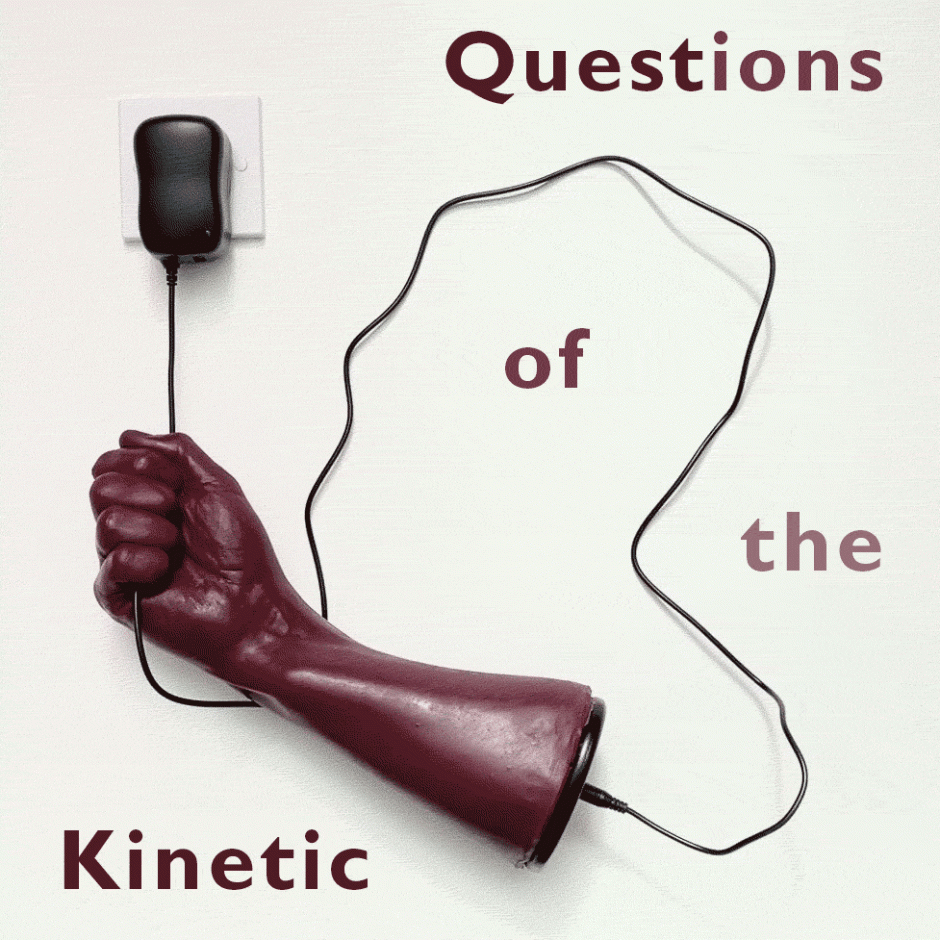
I run workshop programs within Galleries, Arts and educational institutions that use the making of kinetic sculptures to think about The Body and Politics in relation to Technology.
I recently had a conversation with a colleague – Shenece – about the nature of being a nomadic educator.
She said something very inspiring to me about her teaching practice and how she views herself as an Artist Educator as a Node of information, the connective tissue between different groups, ideas,institutions, the integer between fragments. I want to use this discussion as an inspiration and basis upon which I frame an auto-ethnographic exploration of Artist’s workshops.
- What sources will you read or reference? Share 5 to 10.
a. Morozov, E., 2013. To Save Everything, Click Here: Technology, Solutionism, and
the Urge to Fix Problems that Don’t Exist. London: Allen Lane.
b. Groys, B. (2009). “Education by Infection.” In: Madoff, S. H., Art School
(Propositions for the 21st Century), Cambridge, MA: MIT Press, pp. 27
c. Fisher, M. (2016) The Weird and the Eerie. London: Repeater Books.
d. Gauntlett, D. and Holzwarth, P. (2006) ‘Creative and visual methods for exploring
identities’, Visual Studies, 21(1), pp. 82–91.
e. Zembylas, M. (2015) ‘Pedagogy of discomfort and its ethical implications’, Ethics
and Education, 10(1), pp. 163–174.
f. Claire Bishop (2012) – Artificial Hells: Participatory Art and the Politics of
Spectatorship
g. Rodney, D. (ed. various), 2025. Donald Rodney: A Reader. London: Whitechapel
Gallery
h. Peter A. Hall & Pablo Dávila (2022) – Critical Visualization: Rethinking the
Representation of Data
i. Carello, J. & Butler, L. D. (2015) ‘Practicing What We Teach: Trauma-Informed
Educational Practice’, Journal of Teaching in Social Work, 35(3), pp. 262–278.
j. Slavoj Žižek on Synthetic Sex and “Being Yourself”
k. Southpark – - “Sickofancy” (Season 27, Episode 3)
- “Deep learning” (Season 26, Episode 4)
l. Le Guin, U. K. (2019) The Carrier Bag Theory of Fiction. London: Ignota Press.
m. C19 Podcast –
https://soundcloud.com/c19podcast/s09-e02-how-do-we-teach-literature-when-stu
dents-wont-read-what-we-assign
n.
- What action(s) are you planning to take, and are they realistic in the time you have
(Sept-Dec)? I want to interview Artist Educators: Shenece Oretha, Roshni Bhagotra and Ruth Claxton to discuss the potential of artist-led educational resources adjacent to or outside of institutions. I will also attend a discussion at Eastside Projects in Birmingham – The Workshop in Artistic Practice 26/11/2025 I then want this discussion to guide me in the creation of some kind of website/open source platform for students/artists/educators to access and share information.
2
- Who will be involved, and in what way? (e.g. colleagues, students, local community…). Note, if any of your participants will be under the age years of 18yrs,
please seek further advice from your tutor. The context to interviewing them in particular is:
Shenece: Artist Educator, Fine Art Lead at Kinston Foundation, Co-founder BOSS Roshni: Artist Educator, Associate Lecturer at CCW, Digital education learning designer for universities and creative organisations, Ruth: Artist Educator, Director of Eastside Projects Birmingham, Founder/ Maker STEAMhouse BCU NB my plan would be to begin each interview with a series of questions, asking the interviewee to describe in their own words how they perceive their role within the arts and education and their perception of what it is to educate What are the health & safety concerns, and how will you prepare for them?
o https://canvas.arts.ac.uk/sites/explore/SitePage/42587/health-and-safety-hub
o https://canvas.arts.ac.uk/sites/explore/SitePage/45761/health-and-safety-policies-and-hi standards
My biggest concern is moderation, if I create an online sharing space, how to or whether to
create rules etc.
This will also be a topic in the questions I will ask the interviewees..
- How will you manage and protect any physical and / or digital data you collect,
including the data of people involved? https://www.bera.ac.uk/publication/ethical-guidelines-for-educational-research-fifth-edition-2024-onl
ine#consent
o https://www.bera.ac.uk/publication/ethical-guidelines-for-educational-research-fifth-edition-2024-onl
ine#privacy-data-storage
● I am asking for their consent to use their answers as reference in my research
● I am not going to be posting their data,
● The research is separate from the action.
● I have asked their consent to quote them on specific topic
● I will redact their names from the raw data
● I will store all information on secure servers and then will delete everything afterwards
3
- How will you take ethics into account in your project for participants and / or
yourself?
o https://www.bera.ac.uk/publication/ethical-guidelines-for-educational-research-fifth-edition-2024-onl
ine#responsibilities-participants
o https://www.bera.ac.uk/publication/ethical-guidelines-for-educational-research-fifth-edition-2024-onl
ine#responsibilities-sponsors
o https://www.bera.ac.uk/publication/ethical-guidelines-for-educational-research-fifth-edition-2024-onl
ine#responsibilities-wellbeing
o See Emotionally Demanding Research PDF on Moodle
I will make sure to get their consent
To ask for their consent of their participation and make them aware of how their responses will
be used, given the choice of staying anonymous.
Where sensitive topics are discussed and they ask to remain anonymous they will remain
anonymous.
Researchers engaged in action research must consider the extent to which their own reflective
research impinges on others, for example in the case of the dual role of teacher and researcher
and the impact on students and colleagues. Dual roles may also introduce explicit tensions in
areas such as confidentiality and must be addressed accordingly.”
(British Educational Research Association [BERA], 2011 [cited in BERA ethical principles])
- The form itself is around 300 words, so with your additions the total length will come to a
maximum of about 1,050 words.