
Recent Comments
I thoroughly enjoyed interviewing my peers and the conversations we had.
Rather than confirming my preconceptions, they pushed me to think more carefully about structure, authorship, moderation, and responsibility in educational and digital spaces. I also recognised my own inexperience as an interviewer, but this iterative learning process ultimately strengthened my research skills and reflexivity.
I am aware that although my initial plan of creating an online resource had to be limited in its depth, I am
What initially felt like a research into the open-source sharing and “alternative education” gradually forced me to confront my own assumptions, blind spots and my own tendencies to overcomplicate things.
Although entirely unintentional, I only realised afterwards that everyone I interviewed are the same generation: we all graduated between 2015 and 2018 and haven’t done an MA Fine Art but are all really interested in education and teaching.
I wonder if it is this ‘millennial’ perception of the changing nature of the internet and financialisation of Higher Education has shaped how we think?
I know that my very millennial attachment to the early internet – the sense of it as a space of sharing, experimentation and collective learning.
However, Through the process of talking to my peers I have become much more aware of how much that space has shifted through the process of enshittification (Foale K 2025) into something far more commercial, surveilled and extractive. Rather than becoming cynical, this realisation has made me more attentive to the ethics of how and why we share knowledge.
It is now explicit to me how knowledge-sharing is a relational and political act.
It has been a complete transition in perception the from ‘utopian’ online spaces of sharing as teenagers, to a commercialised transactional one as adults.
“DIY Culture … keep it nimble” Muhammad Z
I receive education by proxy as an educator
I think my absolute favourite piece of advice from this process that will guide me into the future is:
“( think of ) Teaching as a gift or an object as a gift or a piece of information as a gift. It’s not only what happens in that moment, but what people go on to share about the information they (have) received.” Oretha S
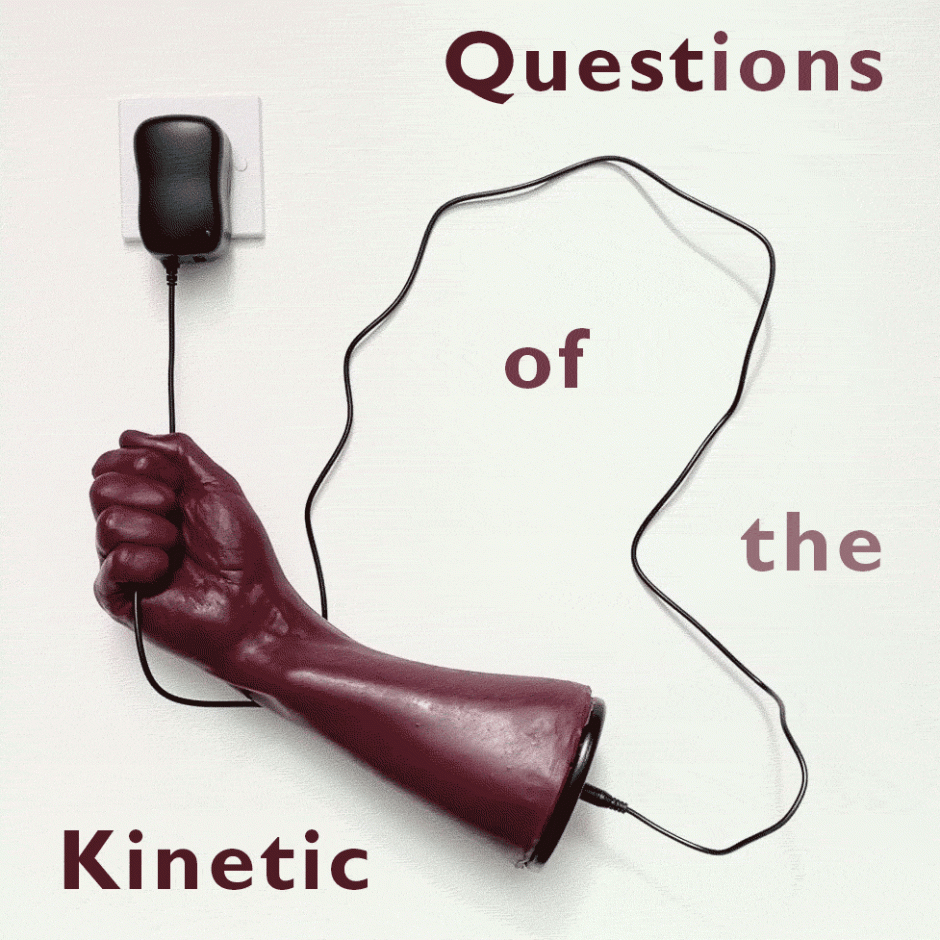
This is the library of information that I am beginning to develop for students and staff to share ideas, methods, materials and theories around kinetic Sculpture
https://artslondon.padlet.org/mmcshane23/why-move-library-fu16ow0x4wbcbav6
In search of carrier bags for teaching kinetic sculpture
Firstly I am so grateful to my interviewees Zarina Muhammad, Roshni Baghotra and Shenece Oretha for the generosity in time and the thoughts that they shared with me. Moreover I would also like to thank Falcon Driscoll and Andrea Machico Francke for sharing their thoughts whilst I was working on this project.
I am really happy in retrospect for how everything played out during and the sequence in which I had the interviews. The meandering approach – really paid off so also thank you to John and Paul for your advice and writings. I also am acutely aware of how terrible I was at interviewing at the beginning and gradually began to improve at focussing the questions better.
Moreover, as soon as my questions came up to the reality of the people I was talking to, it became immediately clear to me that I would need to change my plan and approach to the ARP.
Nodal Mapping of Quallative research
I realised that in trying to fit into some kind of high minded overly broad idea in a relatively new form for me, I had over extended myself in an area that really requires a lot more thought and research. I also realised my own naivety on both the subjects of alternative education and the history and context of different blogging and social media platforms.
It reminded me of season 4 of the American version of the office:
I must resist the urge to ‘Dunder Mifflin Infinity’ my own work. This is in reference to the 3rd and 4th episodes of the 4th season of ‘The Office’ where Ryan the intern is promoted to corporate, and, after stealing someone else’s idea, tries to reinvent the paper company’s website into a social media platform, replete with all the righteous jargon of interconnectivity and streamlining..
Most importantly I had forgotten why I run the Kinetic workshop programs and what their purposes are actually for: To make mechanical, electrical and animatronic principles as accessible as possible to understand,engage with and afford.
Oretha S:
“making it tactile, making it embodied, making it real, making it resonant.”
To get people excited about, to nerd out about and to share the creative potential of moving sculpture….
It made me think of Falcon’s Sample Space at Chelsea and how important it had been for me as a student
Maybe it was possible to make something, physically Nomadic?
A manifesto for nomadic workshop teaching:
Immediately financially accessible – everything has to cost as little as possible
Immediately materially understandable – everything has to be clear in what it is made of
Sequentially clear in complexity – Each idea is broken down into chunks
Sequentially clear in process – Each process leads into and builds upon the next
Materially sensuality and engagement – everything has to be materially engaging
Visual accessibility and resonance – examples incorporate systems from recognisable objects, movements from the outside world
Create the library:
Laurillard (2012) argues that digital technologies are most effective when they enhance, rather than replace, face-to-face teaching.
ARP 2025-26
Ethical Action Plan (500-750 words)*
This document is a chance for you to begin shaping your project while thinking through its
ethical considerations, implications, and responsibilities. We know this might feel early in your
action research journey, but this short plan is here to help pin down your ideas and
work-in-progress.
Use whatever writing format that suits you – lists, bullet points, statements or paragraphs – and
follow the suggested links stated alongside some of the questions for guidance.
A good starting point is the BERA Guidelines for Educational Research, fifth edition (2024)
alongside the ‘Ethics Files and Resources’ on Moodle.
When you’re ready, email your draft to your allocated tutor 48 hours in advance of you first
group tutorial in the week commencing 6 October 2025, so it can help guide the focus of
discussions and support your project development.
Name: Michael McShane
Tutor:John O’Reilly
Date: 07/11/25
Title -In search of Carrier bags
Research – using interviews with two-three peers to discuss the ethics of sharing resources outside of, alongside and inside arts educational institutions Action – Creation of some kind of website/open source platform for students/artists/educators to access and share information
I am an Artist working between institutions, Arts and Education, FE and HE, different faculties and academic and technical roles.
I run workshop programs within Galleries, Arts and educational institutions that use the making of kinetic sculptures to think about The Body and Politics in relation to Technology.
I recently had a conversation with a colleague – Shenece – about the nature of being a nomadic educator.
She said something very inspiring to me about her teaching practice and how she views herself as an Artist Educator as a Node of information, the connective tissue between different groups, ideas,institutions, the integer between fragments. I want to use this discussion as an inspiration and basis upon which I frame an auto-ethnographic exploration of Artist’s workshops.
l. Le Guin, U. K. (2019) The Carrier Bag Theory of Fiction. London: Ignota Press.
m. C19 Podcast –
https://soundcloud.com/c19podcast/s09-e02-how-do-we-teach-literature-when-stu
dents-wont-read-what-we-assign
n.
2
● I am asking for their consent to use their answers as reference in my research
● I am not going to be posting their data,
● The research is separate from the action.
● I have asked their consent to quote them on specific topic
● I will redact their names from the raw data
● I will store all information on secure servers and then will delete everything afterwards
3
I will make sure to get their consent
To ask for their consent of their participation and make them aware of how their responses will
be used, given the choice of staying anonymous.
Where sensitive topics are discussed and they ask to remain anonymous they will remain
anonymous.
Researchers engaged in action research must consider the extent to which their own reflective
research impinges on others, for example in the case of the dual role of teacher and researcher
and the impact on students and colleagues. Dual roles may also introduce explicit tensions in
areas such as confidentiality and must be addressed accordingly.”
(British Educational Research Association [BERA], 2011 [cited in BERA ethical principles])
Baghotra, R. (2025) Interview with McShane M, 05/01/26, Teams.
Bishop, C. (2012) Artificial Hells: Participatory Art and the Politics of Spectatorship. London: Verso.
Bishop, C. (2024) Disordered Attention: How We Look at Art and Performance Today. London: Verso.
Cappello, N. (2024) ‘Body as Classroom: Movement-based Performing Arts as …’. International Journal of Education & the Arts (PDF).
Curtis, A. (2011) All Watched Over by Machines of Loving Grace: Episode 2 – The Use and Abuse of Vegetational Concepts. Television documentary. London: BBC.
Dunderpedia: The Office Wiki (no date) Dunder Mifflin Infinity. [online] Available at: https://theoffice.fandom.com/wiki/Dunder_Mifflin_Infinity (Accessed: 13 January 2026).
Fisher, M. (2016) The Weird and the Eerie. London: Repeater Books.
Foale, K. GeeksForSocialChange (2025) Our plan to build bottom-up resistance to billionaire technology.
Foale, K. GeeksForSocialChange (2025) The White Pube Website Overhaul.
Foale, K. GeeksForSocialChange (2025) What’s the best way to make my personal website?
Francke, A. (2025) Interview with McShane M, 07/01/26, WhatsApp.
Gauntlett, D. and Holzwarth, P. (2006) ‘Creative and visual methods for exploring identities’, Visual Studies, 21(1), pp. 82–91.
Groys, B. (2009) ‘Education by Infection’, in Madoff, S. H. (ed.) Art School: Propositions for the 21st Century. Cambridge, MA: MIT Press, p. 27.
Hooks, b. (1994) Teaching to Transgress: Education as the Practice of Freedom. New York: Routledge.
Le Guin, U.K. (1986) ‘The carrier bag theory of fiction’, in Dancing at the Edge of the World: Thoughts on Words, Women, Places. New York: Grove Press, pp. 165–170.
Laurillard, D. (2012) Teaching as a design science: Building pedagogical patterns for learning and technology. London: Routledge.
McLuhan, M. (1964) Understanding Media: The Extensions of Man. New York: McGraw-Hill.
Morozov, E. (2013) To Save Everything, Click Here: Technology, Solutionism, and the Urge to Fix Problems that Don’t Exist. London: Allen Lane.
Muhammad, Z. (2025) Interview with McShane M, 18/12/25, Teams.
Office for Students (2022) Regulatory Framework for Higher Education in England. London: Office for Students. Available at: https://www.officeforstudents.org.uk/media/1231efe3-e050-47b2-8e63-c6d99d95144f/regulatory_framework_2022.pdf (Accessed: 15 January 2026).
O’Kane, P. (2017) Technologies of Romance – Part I. London: Eeodo.
O’Kane, P. (2018) Technologies of Romance – Part II. London: Eeodo.
Oretha, S. (2025) Interview with McShane M, 08/01/26, Teams.
Postman, N. (1993) Technopoly: The Surrender of Culture to Technology. New York: Vintage Books.
Sarkar, A. (2025) Minority Rule: Adventures in the Culture War. London: Bloomsbury Publishing.
The White Pube (2024) Poor Artists. London: Particular Books.
Turkle, S. (2011) Alone Together. New York: Basic Books.
Presentation
(I have really suffered with this blogs uploading system for HTMLs everything previews beautifully but then refuses to save, in incognito, with cookies removed, with widgets changed please for future students can there be a better way or place for loading files?)
https://docs.google.com/presentation/d/1pEt1PLgjEhoWJKueT4lRY9GnNtBCXoLTVIRjlJGoBuc/edit?usp=sharing
After attending the workshop in Birmingham and the tutorial with John I have decided to change the angle of my approach and focus instead on the spaces of sharing information – slightly broader in one way but hopefully I avoid some of the cynicism and focus more on tangible changeable things.
Below are the following people I plan to interview along with the rationale of why I want to interview them and the scaffolded question that I intend to ask them about.
Shenece Oretha – Topics and themes – Blended spaces, online formats and spaces, live performance and embodied education. Sound Art
Shenece is the senior Fine Art Lead for the Foundation Course at Kingston University. I first met her after we were both running crits at Chelsea College of Art and started discussing our mutual love of Foundation; the fast pace and energy that it brings. She then got me into Kingston to run a super condensed version of the kinetic sculpture workshop which has been an absolute pleasure for the last few years. I want to interview her after a conversation we had about being a nomadic educator and the performance of teaching. – In previous blog posts I have referenced her style and presence as an inspiration for how I approach teaching. I am also personally really inspired by the way she intertwines narrative, materiality and sound in her performances.
In Italics below is the text that I sent to Shenece before interviewing her:
I’m really interested in how you show your research and collaborators on your website.
I came away from our last conversation about being a nomadic educator/artist feeling very inspired.
Since looking more indepth into your website I’m really interested and excited by how you present your work, ideas, research and collaborators on your artist website.
I’m really interested in your live performances, how ideas are communicated non verbally and time specific.
Roshni Bhagotra – Topics – Non hierarchical space, alternative spaces of education, working within education, Public broadcasting and radio, Sound Art
Roshni is a senior digital learning coordinator for UAL I met Roshni at University – she was in the year above me – and we have stayed in touch ever since, meeting up in Birmingham, London and in various roles working within UAL. Since then we have had many conversations about education, technology and accessibility – usually over pints and so I want to finally try to record or capture some of our conversations
I want to explore the potential of creating a nomadic repository of information that can travel between institutions, galleries and cities: A platform/physical/digital space to contain and share information on performing kinetic sculpture whether that be examples, code, thoughts, suppliers,
I already have large amounts of this kind of information, however I want to explore the ethics of how and the format with which this information is shared and presented. Moreover with the rapid development of AI in relation to open source platforms I want to really think about questions of authorship and agency before undertaking this project.
I’m really interested in your dual/triple perspective of working within both educational institutions and alternative educational institutions at the same time.
I’m particularly interested in how ideas and information are shared within alternative educational spaces compared to UAL;
I really like Rounded radio as a space of sharing and discussion. How do you decide who to chat to and the topics of conversation?
Zarina Muhammad along with Gabrielle de la Puente are the creators of the White Pube –
I met Zarina through Chelsea College of Art as we are both working with BAFA2 this year. I had been a big fan of their blog and the establishment of the Funding Library
Topics – Alternative, critical space of education
I’m really inspired by the way you and Gabrielle, through the White Pube, provide/expose ideas and information that reflects a lot of the actual realities of the art world, information that has been/can be largely absent from Arts Education. Here are a few questions around the ideas that I would want to talk to you about:
I’m reading Claire Bishop’s Artificial Hell’s and I keep thinking about the way you describe the language of funding applications.
I was really interested in one of your latest posts about someone training a large language model on your library to then make it an exclusive resource for profit.