Within Arts education I work between FE and HE where I also work in different faculties and within different academic and technical roles, currently:
I work at Chelsea College of Arts where I am just starting as a BAFA2 writing Tutor,
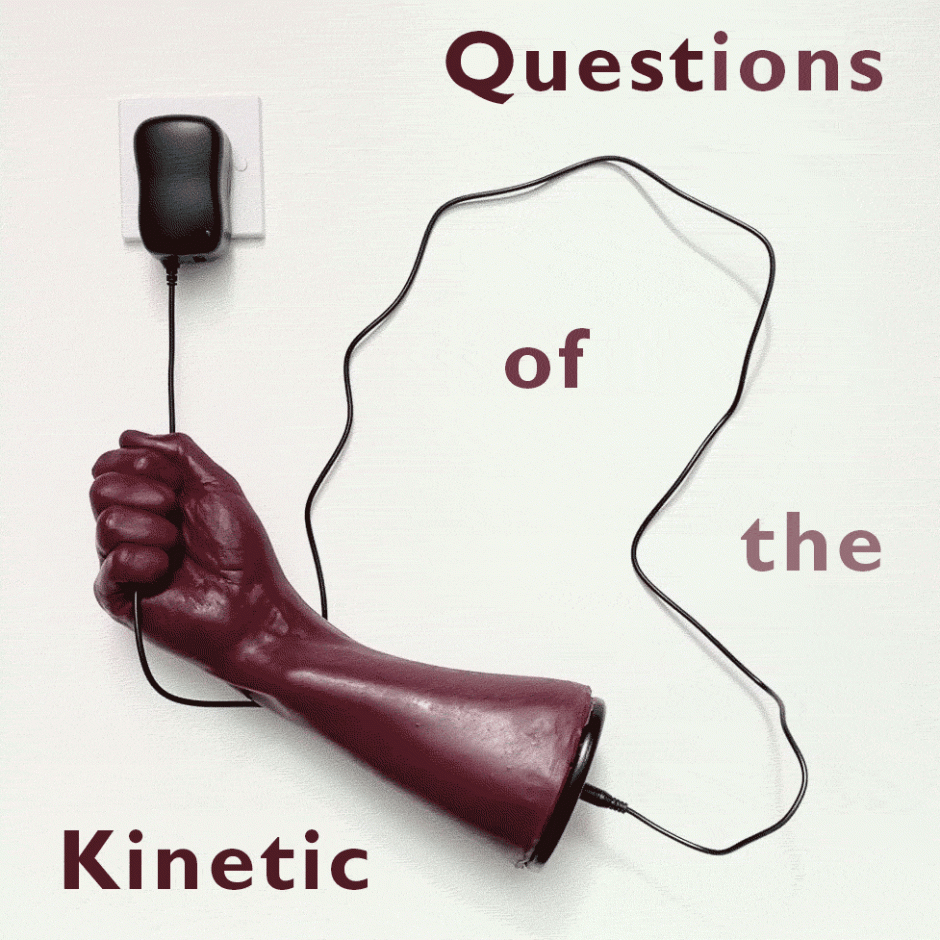
I also run a workshop program there which will start in January on kinetic sculpture and the Body in relation to Technology. It is here, working on and supported by the BA Fine art course that has enabled me to be on the PGCert course.
I am a freelance Metal and Foundry Technician at City and Guilds Art School London where I teach students a range of processes, ideas and techniques around metal fabrication, metal casting, mould making, material sciences, mechanics, kinetics, sculpture and mount making.
I am a visiting practitioner at Kingston Foundation course where I run a workshop program in performing and kinetic sculpture.
I also run workshop programs within Galleries and Arts institutions that use the making of kinetic sculptures to think about the Body and Politics in relation to Technology.
Recent workshops:
Make your skin crawl, LAS Community space, Deptford London, 2025
Automata, Kingston Foundation 2025
Chaotic Human Simulations, STEAMhouse BCU Birmingham, 2023
Back to the ARP
Thinking about where I can make any form of difference whatsoever I am at a loss, as the only teaching hours I have for the rest of term at UAL are as a writing tutor and to be honest I want to plan and learn from those sessions as much as possible without having to think about their relationship to data or the PG Cert. I want to be humble and learn from my peers within that context as much as possible as it is so new to me.
The one consistency across the three spaces I work in are my workshop programs.
I always want to improve my Kinetic workshop program, its ability to connect students and artists and to inspire and make more accessible the ideas behind kinetics. However, I have no more teaching time allocated before January to complete this and I already worked on it in the intervention part of my PGcert and I am anxious not to just repeat myself. In the only Group Tutorial I attended it was suggested to focus on an autoethnographic approach – to be honest I am still slightly unsure as to what the means.
Over the last 5 years I have taught myself the basics of electronics, mechanics and coding using open source information on resources such as Github, Arduino, LastMinuteEngineer etc. This has enabled me to begin teaching it to others and I wouldn’t be where I am today without the generosity of so many creatives and thinkers. I am truly inspired by the ideology of open source information.
As discussed in my original blog post 2 (The UK’s relationship to STEM and the Arts), I agree with Ashton H’s assertion that the dichotomy between STEM subjects and the Arts is holding back students from lower SES from participating in the arts. Moreover, as discussed in OG blog post 3 (Foreign experience of Pedagogy) I agree with the House of Lords Social Mobility Committee report (2014) that the dichotomy between academic and technical teaching needs to be broken down.
In my intervention last year I began implementing new methodologies into my teaching practice for the kinetic workshop; such as the use of padlet as a repository of information, object orientated methodologies through the expanded use of physical examples and student led narrative generation alongside a focus on improving the pacing and syntax of teaching technical and academic ideas simultaneously.
However, due to the contingent nature of my teaching practice I find my resources spread thin and stuck in different online institutional clouds and physical stores, making it difficult to transfer information between spaces. Moreover, as Kumoshiro states in ‘Toward a theory of anti-oppressive education:
Anti-oppressive education must be continuous, multifaceted, and embedded in all aspects of practice.
Therefore I will use a conversation with John in the only tutorial I have attended so far as inspiration:
I am not sure if I understood John correctly in reference to Ursula Le Guin’s carrier bag theory of history. However misunderstanding can be as creative as understanding so I shall plow ahead with my ignorance. I want to develop such a carrier bag, explore different materials to make it from, different ideas and objects to fill it with and different places to take it.
I want to explore the potential of creating a nomadic repository of information that can travel between institutions, galleries and cities: A platform/physical/digital space to contain and share information on performing kinetic sculpture whether that be examples, code, thoughts, suppliers,
I already have large amounts of this kind of information, however I want to explore the ethics of how and the format with which this information is shared and presented.
Moreover with the rapid development of AI in relation to open source platforms I want to really think about questions of authorship and agency before undertaking this project.
I therefore want to interview peers who have already undertaken or use similar methodologies for their own practices.
I want to ask them questions about:
Why do they do what they do?
Moderation – who decides on what is shared and how?
Authorship – how is the authorship of what share demonstrated/protected/subverted?
Privacy – how do they decide on what to share and respect the privacy of others?
Agency – Both theirs and the people on their platforms
My aspiration would be to create a space or resource for the sharing of ideas about Kinetic sculpture students, artists and educators can share technical and academic thought between different institutions.