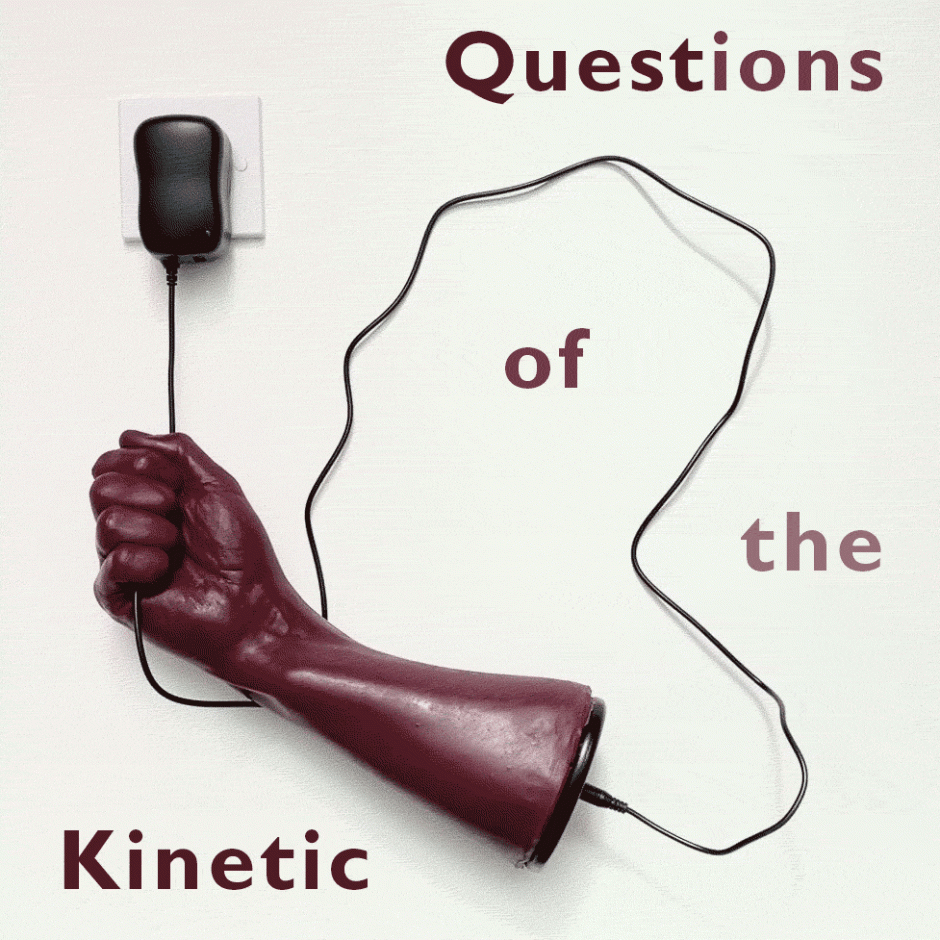
After attending the workshop in Birmingham and the tutorial with John I have decided to change the angle of my approach and focus instead on the spaces of sharing information – slightly broader in one way but hopefully I avoid some of the cynicism and focus more on tangible changeable things.
Below are the following people I plan to interview along with the rationale of why I want to interview them and the scaffolded question that I intend to ask them about.
Shenece Oretha – Topics and themes – Blended spaces, online formats and spaces, live performance and embodied education. Sound Art
Shenece is the senior Fine Art Lead for the Foundation Course at Kingston University. I first met her after we were both running crits at Chelsea College of Art and started discussing our mutual love of Foundation; the fast pace and energy that it brings. She then got me into Kingston to run a super condensed version of the kinetic sculpture workshop which has been an absolute pleasure for the last few years. I want to interview her after a conversation we had about being a nomadic educator and the performance of teaching. – In previous blog posts I have referenced her style and presence as an inspiration for how I approach teaching. I am also personally really inspired by the way she intertwines narrative, materiality and sound in her performances.
In Italics below is the text that I sent to Shenece before interviewing her:
I’m really interested in how you show your research and collaborators on your website.
- Connecting between educational and creative institutions
- Showing research
- Connecting people
- Moderation and permissions of shown research
I came away from our last conversation about being a nomadic educator/artist feeling very inspired.
Since looking more indepth into your website I’m really interested and excited by how you present your work, ideas, research and collaborators on your artist website.
- Why do you show your research on your artist’s website?
- Why do you use the Tumblr format to show this research?
- Do you believe the format of the space of sharing is important?
- Do you share your ideas and research beyond educational institutions and if so how?
- How else do you share your knowledge and research as part of your practice?
- What kinds of spaces do you think it’s important to share ideas on/in?
I’m really interested in your live performances, how ideas are communicated non verbally and time specific.
- Is there anything particularly important to you about sharing things live/physically?
- In your opinion When things are live is it always necessary to document them?
- Do you incorporate any of these principles into your teaching?
Roshni Bhagotra – Topics – Non hierarchical space, alternative spaces of education, working within education, Public broadcasting and radio, Sound Art
Roshni is a senior digital learning coordinator for UAL I met Roshni at University – she was in the year above me – and we have stayed in touch ever since, meeting up in Birmingham, London and in various roles working within UAL. Since then we have had many conversations about education, technology and accessibility – usually over pints and so I want to finally try to record or capture some of our conversations
I want to explore the potential of creating a nomadic repository of information that can travel between institutions, galleries and cities: A platform/physical/digital space to contain and share information on performing kinetic sculpture whether that be examples, code, thoughts, suppliers,
I already have large amounts of this kind of information, however I want to explore the ethics of how and the format with which this information is shared and presented. Moreover with the rapid development of AI in relation to open source platforms I want to really think about questions of authorship and agency before undertaking this project.
I’m really interested in your dual/triple perspective of working within both educational institutions and alternative educational institutions at the same time.
I’m particularly interested in how ideas and information are shared within alternative educational spaces compared to UAL;
- Would you be able to tell me about the Alt ed spaces you’ve been part of?
- At Alt ed places you’ve been part of, how is information shared and distributed?
- Is there any physical resource/space for sharing between peers?
- Is there any online resource/space for sharing between peers?
- Are the spaces centralised or decentralised?
- How do these spaces function, how are they moderated?
- How is information shared outside of the alt ed space (advertising/documenting shows, events etc)?
- How does information transfer from one cohort to another?
- How does this all compare to your experiences of working at UAL?
I really like Rounded radio as a space of sharing and discussion. How do you decide who to chat to and the topics of conversation?
- I enjoyed listening to your interview with Ben Fitton, are there any more/different examples of your practice as an educator crossing over to Rounded Radio?
- Platform you use for rounded radio
Zarina Muhammad along with Gabrielle de la Puente are the creators of the White Pube –
I met Zarina through Chelsea College of Art as we are both working with BAFA2 this year. I had been a big fan of their blog and the establishment of the Funding Library
Topics – Alternative, critical space of education
I’m really inspired by the way you and Gabrielle, through the White Pube, provide/expose ideas and information that reflects a lot of the actual realities of the art world, information that has been/can be largely absent from Arts Education. Here are a few questions around the ideas that I would want to talk to you about:
- Why did you set up the funding library?
- How do you get people to submit their successful applications?
- What other kinds of information/methods of sharing do you think are important or are absent from education for artists these days?
I’m reading Claire Bishop’s Artificial Hell’s and I keep thinking about the way you describe the language of funding applications.
- Do you think that the way that funding applications work shapes what kind of art is made and also the types of education that exist beyond institutions?
I was really interested in one of your latest posts about someone training a large language model on your library to then make it an exclusive resource for profit.
- Are there ways of protecting online content from this kind of process happening?
- Continuing from that, how does authorship work in such an environment, where the act of open source sharing can be exploited by a much larger, elusive power?
- Are there ways of combatting the consumption of original progressive online content by large language models?