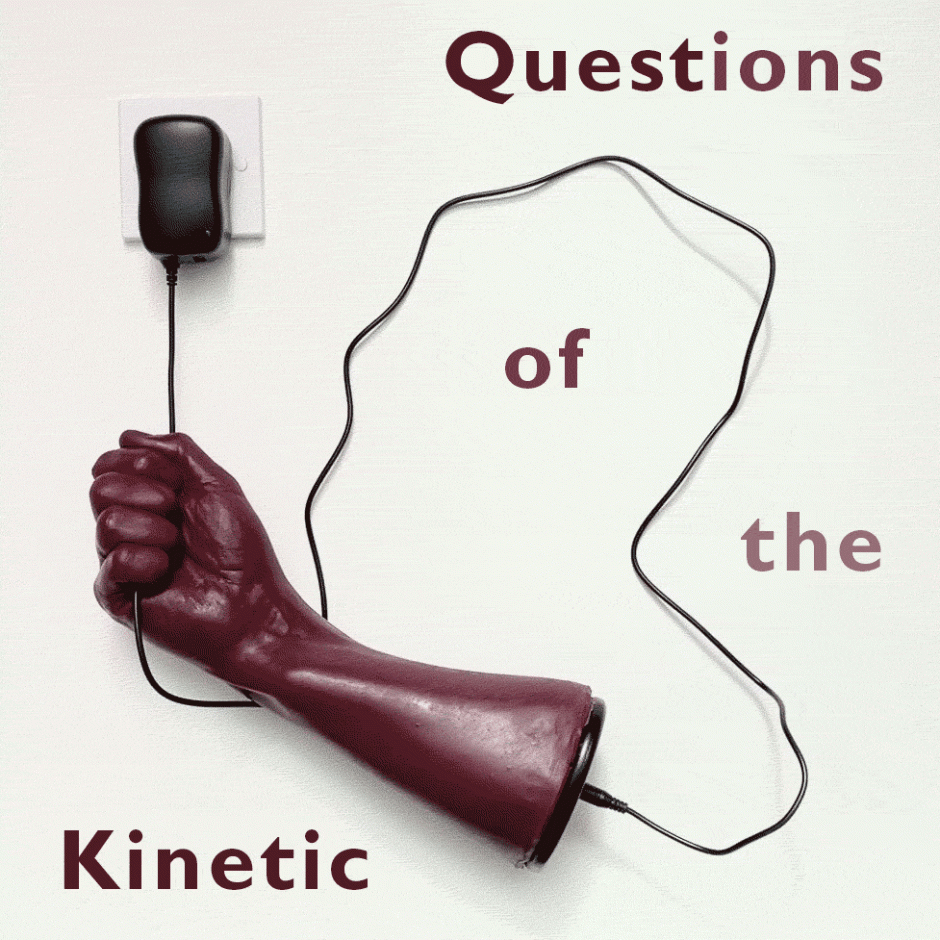
Developing Workshops on Technology and the Body
I want to use what I have learnt from the PG Cert and some of my colleagues to develop and broaden the workshop series I run ‘Technology and its relationship to the Body – The motion of Power in Art and Society’ , especially the Community of Practice club that exists alongside it. As I have limited amount of teaching hours at UAL as I am an HPL
As an Artist and Educator working with diverse cohorts across multiple institutions, I have often observed that although contemporary Art curricula is good at focusing on Critical Theory within an academic context, there is a gap in how it is applied to technology or technical teaching. (See my Blog 1 and Case study 2)
I was inspired by the ideology of open source technology on websites such as Github to provide a space for students to meet and discuss their ideas and work together using kinetic sculpture and electronics within a creative educational context.
Inspired by the work of artists such as Donald Rodney and the community of technologists that surrounded him, I want to create a space where students are brought together through a mutual interest in technology, then given the dialogical space to express their own complex, intersecting identities—particularly race, gender, ability, and religion. Then to use those intersecting narratives to take a critical look at the systems of power and control that surround them , through a communal interest in movement, circuitry, and sculptural form.
In some of my first workshops I was using primarily euro-centric narratives around technology – focusing on the age of enlightenment as a starting point to critique industrial and post industrial technologies. However, through the influence and kind tutelage of a colleague (thanks Shenece) and critical pedagogical frameworks including intersectionality (Crenshaw, 1989), inclusive arts-based practices (Rolling, 2010) and infection (Groys 2009) I decided to develop a new approach to the contents and structure of my teaching sessions.
In this intervention I want to make Kinetic sculpture and physical computing offer material ways of exploring:
- critical theory – The workshops begin with a critical look and group discussion of the history and evolution of technology, how it has been used in Art, Science and Fiction to shape society, its positive and negative attributes and what that even means to the students.
- inclusion – The students then develop ideas from their own work into physical manifestations of performing sculptures, with me acting as a facilitator driving conversation about ideas and technically guiding them through the realisation of their work.
- social justice – One of the key themes we explore in the workshops is the idea of “Technological Solutionism” (Evgeny Morozov, 2013) and the way that Utopian ideas around technology can be masks for systems of control and oppression facilitating the opposite results to those they espouse.
It is my desire to position technology and sculpture as tools for inclusion and personal storytelling, and to build ‘infective’ communities of practice that will facilitate diverse and continued exchanges of ideas throughout and beyond students’ academic life.
The intervention was tested at the end of the academic year and was open to all Students on a sign-up basis. Learners were invited to create a kinetic or electric sculpture that responded to a personal or social narrative involving an aspect of their identity. They were guided to reflect on how systems of power and control shape that identity, using movement and interactive elements to convey lived experiences.
Key pedagogical decisions included:
- Student-led narratives: Learners chose the idea and aspect(s) most meaningful to them, offering autonomy and avoiding prescriptive categories.
- Material engagement: Use of motors, Arduino boards, LEDs and sensors encouraged students to think about how physical movement could metaphorically represent systemic power structures (e.g., forced movement, resistance, repetition).
- Collaborative critique spaces: We met every week in a group to reflect on work together and provide opportunities for dialogue, peer feedback, and emotional processing.
These decisions aligned with inclusive pedagogies as described by Florian and Black-Hawkins (2011), who advocate for “teaching for everyone” rather than for a mythical average learner.
References
Appiah, K. A. (2014) Is religion good or bad?. [Online]. Available at: https://www.youtube.com/watch?v=0CAOKTo_DOk
Boler, M. and Zembylas, M. (2003) ‘Discomforting truths: The emotional terrain of understanding difference’, in Trifonas, P. (ed.) Pedagogies of Difference. New York: Routledge, pp. 110-136.
Carello, J. and Butler, L. D. (2015) ‘Practicing what we teach: Trauma-informed educational practice’, Journal of Teaching in Social Work, 35(3), pp. 262–278.
Crenshaw, K. (1989) ‘Demarginalizing the intersection of race and sex’, University of Chicago Legal Forum, 1989(1), pp. 139-167.
Florian, L. and Black-Hawkins, K. (2011) ‘Exploring inclusive pedagogy’, British Educational Research Journal, 37(5), pp. 813–828.
Gauntlett, D. and Holzwarth, P. (2006) ‘Creative and visual methods for exploring identities’, Visual Studies, 21(1), pp. 82–91.
Groys, B. (2009). “Education by Infection.” In: Madoff, S. H., Art School (Propositions for the 21st Century), Cambridge, MA: MIT Press, pp. 27
Hooks, b. (1994) Teaching to Transgress: Education as the Practice of Freedom. New York: Routledge.
Kumashiro, K. (2000) ‘Toward a theory of anti-oppressive education’, Review of Educational Research, 70(1), pp. 25–53.
Morozov, E., 2013. To Save Everything, Click Here: Technology, Solutionism, and the Urge to Fix Problems that Don’t Exist. London: Allen Lane.
Rolling, J. H. (2010) ‘A paradigm analysis of arts-based research and implications for education’, Studies in Art Education, 51(2), pp. 102–114.
Rodney, D. (ed. various), 2025. Donald Rodney: A Reader. London: Whitechapel Gallery
Tara J. Yosso (2005), “Whose culture has capital? A critical race theory discussion of community cultural wealth.”
Zembylas, M. (2015) ‘Pedagogy of discomfort and its ethical implications’, Ethics and Education, 10(1), pp. 163–174.Rodney, D. (ed. various), 2025. Donald Rodney: A Reader. London: Whi