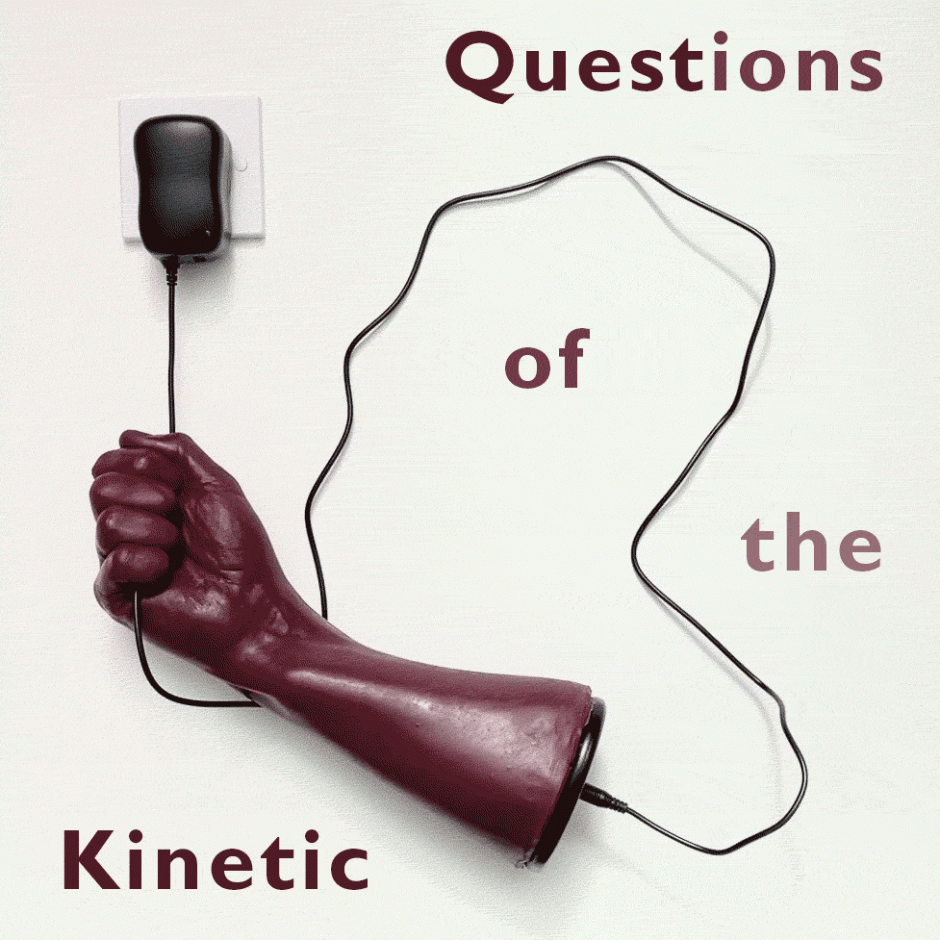
I recently attended a lecture by the artist Faisal Hussein in Birmingham. I have known him for a couple of years and I thought that the talk that he gave was both inspiring and incredibly insightful into the way Muslims have been treated within the UK’s educational system.
His work looks at how the use and introduction of Prevent and its treatment of Muslim children in the education system not only oppressed but exacerbated division between children of different faiths and races. He talked about how muslim children were singled out as potential Islamic terrorists for such normal, teenage things as changing their appearance or being more adventurous.
This then created a situation similar to that described In Islam, Women and Sport (Jawad, 2022) whereby Muslim children in the face of an increasingly oppressive state would use Islamic dress not simply as a personal expression of faith but as a site of resistance. The visibility of Muslim identity becoming a marker of pride in the face of marginalisation.
This then reciprocally exemplifies the preexisting inadequacies and inherent structural bias of the State and educational system: Exemplified by Jawad when she describes the lack of appropriate spaces and provisions in schools for Muslim girls.
Moreover, the stoking of fear through policies like Prevent further sets students apart from each other and increases the frequency of racial and religious stereotyping as described, in Challenging Race, Religion and Stereotypes in the Classroom (Trinity University, 2016), Where one student spoke about being assumed to be Muslim because of their skin tone—highlighting not only racial stereotyping but also a flattening of religious diversity.
I really appreciated the way Appiah encourages us to resist essentialist views of religion. Having witnessed first hand the anger and dogmatic entrenchment of religious and political sectarianism, I believe that it is the simplification, stereotypical portrayal and focus on difference that is the biggest barrier.
In an art and design context, faith may not be explicitly visible, but it deeply informs themes, aesthetics, and motivations. As an educator, recognising this means making space—literally and metaphorically—for faith within creative learning without exoticising or erasing it.
Thank you for this thoughtful and necessary reflection. I really appreciated the way you drew attention to the structural and cultural effects of Prevent, as well as Faisal Hussein’s framing of Islamic dress as both a form of faith expression and a site of resistance. These intersections between visibility, marginalisation, and state surveillance are not only urgent, but deeply entangled with how we think about inclusion and identity in creative education.
I completely resonate with the concern around how expressions of faith—particularly Islam—are often misinterpreted or essentialised, both within educational contexts and wider society. One issue I repeatedly encounter is the careless conflation of “Muslim” and “Islam,” where individuals are labelled or perceived through the lens of reductive or even extremist stereotypes simply for choosing to publicly express their faith. This not only flattens complex identities but can also create a climate of suspicion or discomfort around religious expression.
In my own teaching practice, I’m increasingly interested in how we might foster learning environments where students feel safe and supported in exploring and expressing their identities—religious, cultural, political—through their visual and artistic work. I’d love to see spaces where students can critically engage with their beliefs, experiment with modes of expression, and even challenge dominant narratives, without fear of being seen as radical or out of place. Creating such conditions is essential if we are serious about inclusion and decolonising our creative curricula.
Thank you Antonia, again it was a real pleasure and humbling experience to read your post on the topic and to hear about how you have physically manifested a space to facilitate care and inclusion. It really resonates with me as I often will be working with students in springtime doing exhibition installs and crits and this can be completely exhausting for Muslim students during Ramadan: especially if they are have to talk all day or are doing a physically intensive installations. Your ideas and solutions are an inspiration and I hope to be able to facilitate and push for similar solution in the institutions where I teach