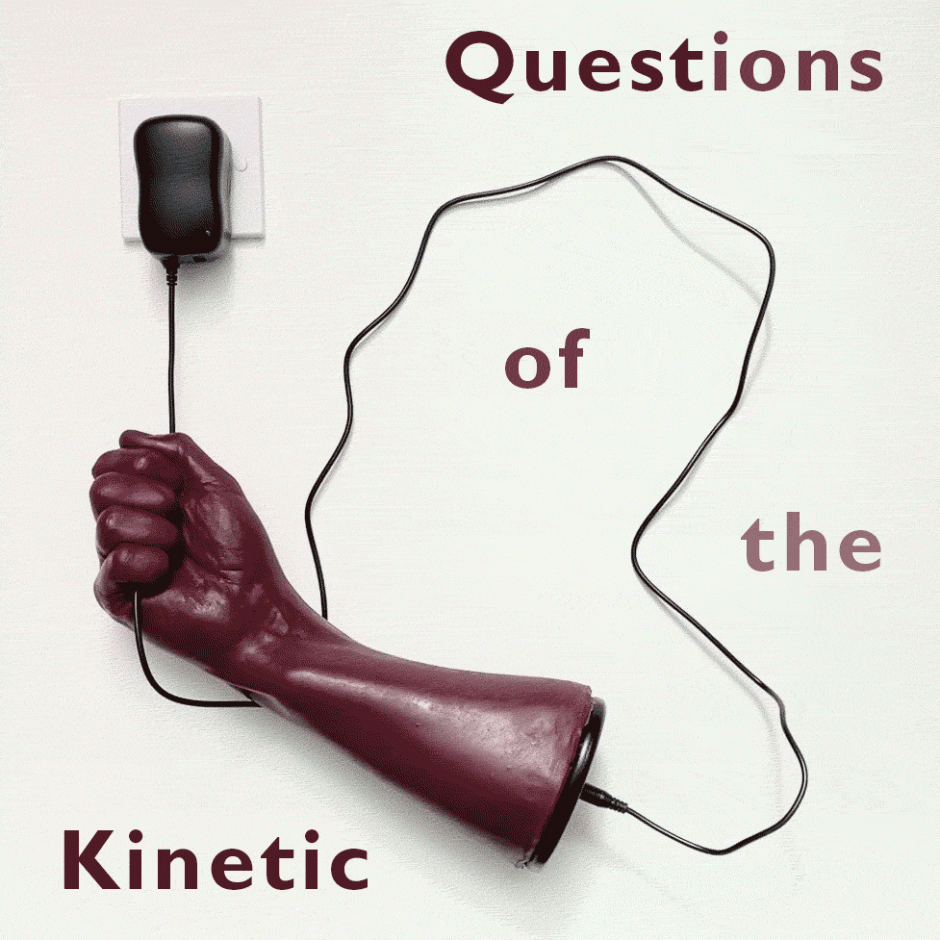

At the beginning of my workshops in Performing and Kinetic Sculpture I often use examples and maquettes as a way to engage students.
The tight format of the micro teach forced me to be extremely deliberate about what I wanted my peers to experience and discuss in such a short time, trying to make their own kinetic or performing sculptures would be unrealistic.
This gave me the idea of trying to combine a method I use for teaching generative writing and zine making, whereby students generate a narrative in a booklet through the unfolding of certain restricted prompts.
One of the key areas I have wanted to work on in my teaching on performing sculpture is to find ways to get students to think beyond the linear and to consider multiple senses and associations simultaneously whilst developing their work: One of the downsides of using examples in sessions is that sometimes students overly mimicking the examples presented and explored instead of generating their own ideas.
Using the ending of the movie Seven as inspiration, I decided to obfuscate the ability of students to see the kinetic examples as images by putting them in various container and trying to focus on sound, gesture, rhythm and sequential association, to generate a narrative about what was in the bags and boxes.
Once my Peers had gone through the process, I would then reveal what was in each bag to explore and discuss the potential simplifications and complexities of different mechanisms and associations in the generation of a viewer’s experience of an artwork
The intention being to use play and obfuscation to scaffold a dialogue about movement and sound in performing sculpture.
All items out of the bag but still in their containers and some of the responses
Revelation of animatronic fist and machine claw within their respective bags
Peer’s imagined narrative existing within each bag
Peers’s imagined contents of the aluminium kebab box and cloth bag
The revealed contents of metal kebab box with motor
Victor Feedback
Mike
Intro to self and activity (new activity)
Offers context
Provides instructions, provides alternatives. Reassures participants preferred ways to
communicate. Monitors time. Gives further instructions and notice of time left.
Asks participants to feel object in bag. Gives more instructions and then participants
share their booklets and narratives
Mike rounds up, explaining context and rationale of activity.
Audience feedback
Will you reveal hidden objects? Will you analyse work produced by students. Not
analytical, more like an aide memoire of the workshop. M explains structure of typical
workshop. Idea is to trigger interaction among students two. Sessions usually up to 12
so scalable up to there. Interesting approach but missed contextualisation. It may be a
tool for discovery. Maybe having one by one (e.g. sound), then feel, etc to help students
process information and focus to account for neurodiversity. Last bit felt a bit repetitive
and challenging because of time constraints. Change of activity (touching) adds variety.
Reflecting on the micro-teaching session that I conducted, the experience was interesting because it was set outside the usual context of Art students who I normally work with.
The feedback from the session was really useful in highlighting areas of improvement. One point of reflection was the need for more contextualization. Although I explained the rationale for the activity and its objectives, some participants felt it lacked a deeper explanation of the context in which the objects and activities were being presented. This manifested in the plurality of responses to the exercise and the confusion over purpose. I think this is a crucial aspect of object-based learning, as students need to understand not only what they’re interacting with but also why the interaction is meaningful.
Written responses
Confused responses
Another valuable piece of feedback was regarding the session’s pacing and structure. Given the limited time, I had to balance the exploration of the object with enough time for students to process and reflect. This I just about managed but did end up rushing and pacing will be something that I will be exploring through and improving on with my observations and case studies.
Lastly, the feedback pointed out that the session became a bit repetitive toward the end, likely due to the tight time constraints. Incorporating more variety in the activities in terms of individual and group working could keep the momentum going and ensure that students remain engaged throughout the session. The challenge of fitting a dynamic and tactile learning experience into such a brief timeframe made me again realise the importance of pacing and variety in keeping the session effective.
Moving forward, I plan to experiment with slower-paced and more structured activities in order to create a more thoughtful and immersive learning experience for students. By allowing more time for each phase of the activity, I can ensure that students don’t feel rushed or overwhelmed, enabling them to absorb and engage with the content at a deeper level. I also aim to integrate clear breaks and moments for reflection, so that participants have the opportunity to process what they’re experiencing and connect it to their own work. This approach should not only help students retain the material more effectively but also foster a more meaningful connection with the workshop, allowing them to recall and apply the concepts long after the session ends.